






Article: What clothing labels tell us and why knowing how to read them matters
What clothing labels tell us and why knowing how to read them matters
How often have we chosen a garment based on its colour, silhouette or the way the fabric feels against the skin, without spending more than a few seconds looking at its label? And yet, hidden within those few centimetres of fabric sewn into a seam are some of the most important details about what we are about to wear. Fibre composition, country of manufacture, washing instructions and treatments to avoid can tell us a great deal about the quality of a garment, how it was made and the care it will need over time.
Clothing labels, however, are not always easy to understand. Percentages, symbols and abbreviations can feel like a language designed more to confuse than to inform. So we end up ignoring them, cutting them off as soon as we get home or checking them only when the damage has already been done: a felted sweater, a misshapen fabric, a colour that has lost its intensity after just a few washes.
Learning how to read clothing labels helps us avoid these mistakes, but it means much more than that. It allows us to make more informed choices, distinguish an appealing description from the actual composition of a garment and understand whether the material in front of us is truly suited to our needs. It also means recognising that the lifespan of a garment depends not only on how it was made, but also on how we choose to care for it.
From fibre names and laundry symbols to new traceability technologies and the Digital Product Passport, every piece of information adds another chapter to the story of what we wear. A story worth reading before we buy, rather than discovering when it is too late. Because understanding a garment is the first step towards choosing it more carefully, respecting its materials and keeping it pleasant against the skin, season after season.

Table of Contents
- What can we really learn from a clothing label?
-
Fabric composition: learning to recognise fibres
- How to understand laundry symbols without making mistakes
- What does “Made in” really mean
- RFID and supply chain traceability
- Towards the Digital Product Passport
- Is a label enough to recognise a quality garment?
What can we really learn from a clothing label?
When we choose a garment, our attention naturally goes to its colour, silhouette and the way the fabric feels to the touch. These are important elements, but they do not tell the whole story of a product. To truly understand what we are buying, we need to look beyond the surface and find the label.
In the European Union, textile products must provide clear information about their fibre composition. The relevant legislation is EU Regulation No. 1007/2011, introduced to ensure that consumers receive accurate and consistent information about the materials used. Fibre composition must be stated using the official fibre names and must be legible, visible and securely attached to the product.
Not all the information found on labels serves the same purpose, however. A garment may include several different elements:
-
a brand and size label;
-
a fabric composition label;
-
information about the country of manufacture;
-
washing and care symbols;
-
any certifications;
-
a code, QR code or RFID system for identification and traceability.
The first distinction to make, therefore, is between fibre composition labels and care labels. The former tell us what the garment is made of. The latter explain how to care for it without compromising its quality. They provide different information, but the two are closely connected: we cannot properly care for a fibre without knowing which fibre we are dealing with.
Reading the label before buying can also help prevent false expectations. Two sweaters that look very similar can have very different compositions and behave completely differently once worn. One may be naturally breathable and pleasant against the skin, while another may retain more heat or moisture. One may preserve its appearance for a long time, while another may quickly lose its shape.
A label cannot determine the absolute value of a product on its own, but it gives us the tools to assess it more clearly. In a market where words such as “natural”, “premium”, “sustainable” and “responsible” are used very freely, concrete information matters more than promises.
Fabric composition: learning to recognise fibres
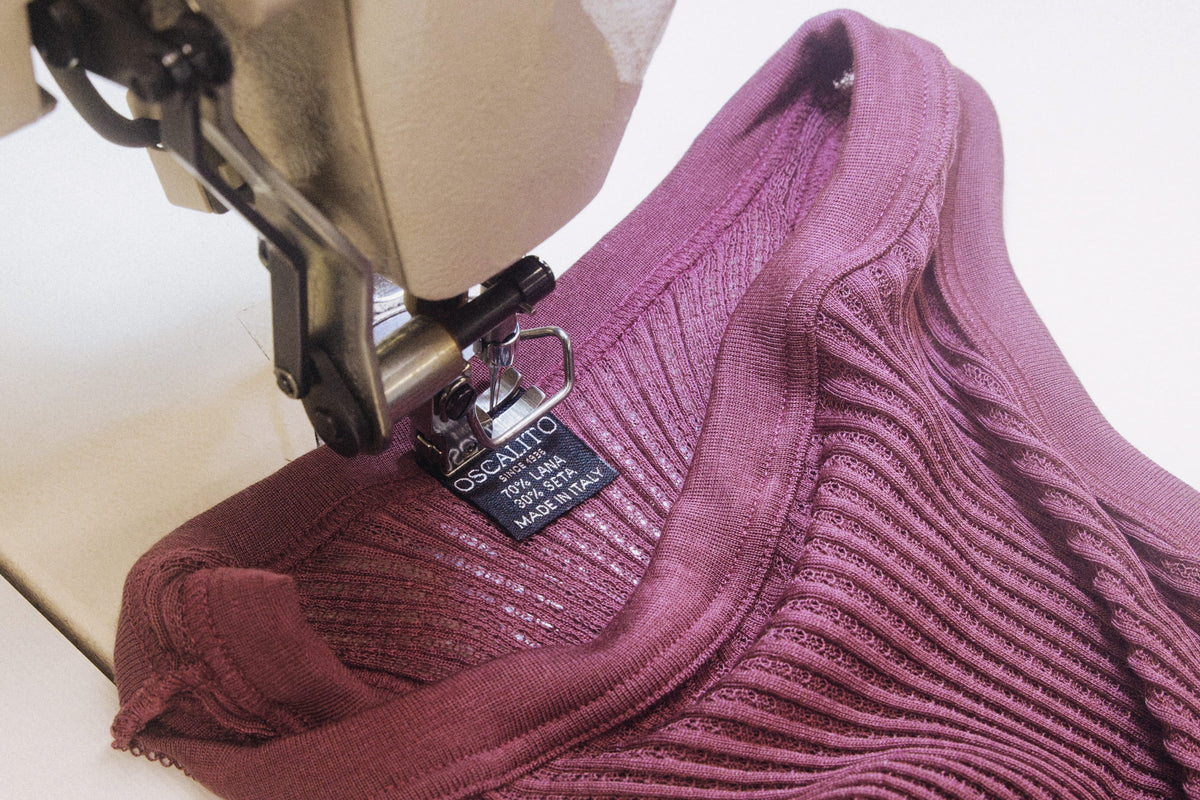
Fabric composition is normally expressed through one or more percentages. A label might state, for example, “100% cotton” or indicate a blend of fibres, as in our wool and silk garments, where the blend is “70% wool, 30% silk”.
When a garment is made from a single fibre, the information is straightforward. When we encounter a blend, it is useful to understand the role played by each component.
Natural fibres come from plant or animal sources. Among the most widely used in clothing are cotton, linen, wool and silk. Each has specific characteristics that influence the hand of the fabric, its ability to absorb moisture and the way it feels against the skin.
Alongside natural fibres are man-made cellulosic fibres, obtained by transforming natural raw materials through industrial processes. Modal, Micromodal, viscose and lyocell are examples. Simply describing them as “synthetic” would be incorrect, as both their origin and production process differ from those of fibres such as polyester.
Synthetic fibres, including polyamide, acrylic and polyester, are instead mainly derived from polymers produced through chemical processes. They can provide elasticity, abrasion resistance, lightness or quick-drying properties. This is why they are often included in small percentages even in garments made primarily from natural fibres.
The presence of a synthetic fibre does not automatically make a product poor quality, just as the words “100% natural” do not guarantee superior quality on their own. Much depends on the material chosen, the length and fineness of the fibre, the spinning process, textile processing, garment construction and the function the garment is intended to perform.
A small percentage of elastane, for example, can help a close-fitting fabric follow the body’s movements and recover its shape. A very high percentage of polyester in a garment designed to be worn directly against the skin, on the other hand, may not provide the same breathability as a high-quality natural or cellulosic fibre.

In what order are fibres listed?
On fabric composition labels, fibres are generally listed in descending order by weight. The first percentage therefore indicates the predominant fibre.
A garment made from “85% wool and 15% silk” will behave primarily according to the characteristics of wool, while silk may add lustre, lightness and a softer hand. In a composition of “70% cotton and 30% polyamide”, by contrast, the synthetic fibre will have a more noticeable influence on the fabric’s structure and performance.
It is important to read every entry rather than stopping at the first one. Some garments consist of different components, such as the main fabric, inserts, lining, lace or padding. In these cases, the label may list the composition of each component separately.
What do “pure”, “virgin” and “recycled” mean?
Some terms deserve particular attention. “Pure virgin wool”, for example, is not simply another way of saying wool. It indicates fibre that has not previously been used and has not been recovered from the processing of existing products.
The word “recycled”, meanwhile, should be accompanied by the name of the fibre and its corresponding percentage. A generic sustainability claim on the packaging does not replace transparent information about composition.
Learning to read fabric composition labels also means being cautious about vague expressions. “Silk effect”, “cashmere touch” or “wool feel” describe a sensation or aesthetic effect, not the actual presence of those fibres. To know what we are buying, we need to look for fibre names and percentages.
How to understand laundry symbols without making mistakes
Once we understand the composition, there is still the part that most often puts our memory to the test: care labels and their symbols. The international system divides care instructions into five main categories, usually presented in the same order:
-
washing;
-
bleaching;
-
drying;
-
ironing;
-
professional cleaning.
The symbols indicate the maximum permitted treatment. This means that we can choose a gentler treatment than the one shown, but we should not exceed the indicated intensity, temperature or mechanical action. GINETEX collects and explains the harmonised symbols established by ISO 3758, providing a comprehensive overview of textile care instructions.

The wash tub: washing with water
The wash tub symbol refers to washing with water. The number inside indicates the maximum recommended temperature, not a mandatory one. A wash tub marked 30°C therefore tells us that the garment should not be washed at a temperature above 30°C. Choosing a lower temperature is possible, provided it is sufficient to clean the garment properly.
The lines beneath the wash tub indicate how gentle the cycle should be:
-
no line: normal cycle;
-
one line: moderate or gentle cycle;
-
two lines: very gentle cycle.
A hand inside the wash tub indicates hand washing, while a crossed-out wash tub means that the garment must not be washed with water. “Hand wash” does not mean vigorously rubbing the fabric. On the contrary, it requires gentle movements, limited washing time and a controlled temperature. Wringing the garment to remove water can deform fibres and seams, particularly with wool, silk or lightweight constructions.
The triangle: bleaching
Among the less intuitive clothing care symbols is the triangle, which refers to bleaching. An empty triangle allows the use of bleaching agents; a triangle crossed by two diagonal lines permits only oxygen-based, non-chlorine bleach; a crossed-out triangle, or the older solid crossed-out triangle, means that the garment must not be bleached.
This symbol does not refer only to traditional bleach. Some stain removers may also contain bleaching agents that can alter colour or weaken fibres. Before applying a product directly to the fabric, it is always wise to check its composition and test it on an inconspicuous area.
The square: drying
The square contains instructions relating to drying. When it contains a circle, it refers to tumble drying.
The dots inside the circle indicate the temperature level:
-
one dot: low temperature;
-
two dots: normal temperature.
A crossed-out symbol indicates that the garment must not be tumble dried.
Different variations of the square indicate specific methods of natural drying: a horizontal line means dry flat, a vertical line means line dry, two vertical lines indicate drip drying, while a line in the upper corner indicates drying in the shade. These are not insignificant details. A wet knitted garment can become considerably heavier and lose its shape if hung vertically. Drying it flat helps preserve its proportions and structure.
The iron: temperature and steam
The iron symbol indicates whether a garment can be ironed and the maximum permitted temperature. One dot corresponds to a low temperature, up to 110°C; two dots to a medium temperature, up to 150°C; and three dots to a high temperature, up to 200°C. A crossed-out iron means that the garment must not be ironed, while a symbol with crossed-out steam lines indicates that an iron may be used, but without steam.
The circle: professional cleaning
The circle is reserved for professional cleaning. The letters inside provide professional cleaners with information about the solvents and processes that may be used.
A crossed-out circle means the garment must not be dry cleaned. When one or two lines appear beneath the symbol, a gentler process is required.
There is no need to memorise everything, but it is important to recognise the circle and understand when a garment should be entrusted to a professional, particularly when it features complex constructions, linings, embroidery, lace or combinations of different materials.
What does “Made in” really mean?
The words “Made in” seem to provide an immediate answer: they indicate the country to which the garment’s origin is attributed. They do not, however, mean that every stage of production took place in the same country. A fibre may originate in one country, be spun and woven in another, and then travel elsewhere for final manufacturing.
The textile supply chain can involve numerous stages, from producing or harvesting the raw material to spinning, dyeing and fabric processing, followed by cutting and garment manufacturing. The country stated on the label does not necessarily list all these locations. Instead, it identifies the product’s origin according to the applicable rules, which take into account the processing carried out and, in particular, the last substantial transformation.
Even a prestigious designation such as “Made in Italy” should therefore be understood for what it actually communicates: it does not automatically certify that the fibres are Italian or that every stage of production took place in Italy. It may mean that the garment acquired its origin in Italy through a process considered decisive, while materials and previous operations may have come from elsewhere in the world.
Moreover, European legislation on textile labelling primarily requires clear disclosure of fibre composition, while indicating the country of origin is not a generally mandatory requirement for all garments marketed within the European Union.
“Made in” therefore remains significant information, but it cannot reconstruct the entire supply chain on its own. To understand more precisely where the different stages took place, where the materials came from and which parties were involved in production, additional information is required. This is where digital traceability systems come into play.
RFID and traceability along the supply chain
Alongside traditional composition labels, technologies capable of storing much more information are becoming increasingly common. One of the most widespread is RFID, which stands for Radio-Frequency Identification.
An RFID system uses a small tag with an electronic identity that can be read using radio frequency. Unlike a standard barcode, it does not necessarily require direct optical scanning and can allow individual products to be identified through a unique code.

In the fashion and clothing industry, this technology can be used to manage inventory, check product availability, improve stock accuracy and follow a garment through different stages of the supply chain.
RFID does not automatically mean complete traceability. The tag is a tool: the quality of the information depends on the data collected, the systems used to connect it and the company’s willingness to make that information accessible.
GS1 standards provide for the use of EPC/RFID codes and tags to identify products and collect data useful for traceability. These technologies can connect an item to additional information such as batch, location and stages in the distribution chain.
For consumers, the potential advantage is significant. A garment no longer has to be represented simply by a generic line in a database: it can have its own identity, linked to information documenting its journey.
Technology, however, does not replace responsibility. A digital label can contain a huge amount of data and still offer very little transparency. What matters is that the information is verifiable, understandable and genuinely useful.
Towards the Digital Product Passport
The next step in the evolution of labelling is the Digital Product Passport, often referred to as the DPP.
Introduced within the framework of the European Ecodesign for Sustainable Products Regulation, the Digital Product Passport is conceived as a tool for collecting and sharing relevant product information throughout its life cycle. The European Commission is working with stakeholders in the textile sector to define which data will need to be included and how it should be provided.
Depending on the rules established for different product categories, the Digital Product Passport may include:
-
materials and composition;
-
origin of raw materials;
-
production processes;
-
care instructions;
-
information on repairability;
-
presence of relevant chemical substances;
-
information useful for reuse and recycling;
-
certifications and supply chain documentation.
For the fashion industry, this represents a profound change. Today, a great deal of information becomes fragmented between suppliers, manufacturers, distributors and retailers. By the time a garment reaches the person who buys it, its story has often been reduced to a few percentages printed on a small label.
The Digital Product Passport could make this story more accessible, helping consumers distinguish a generic claim from verifiable information, making repairs easier and enabling recycling operators to identify materials more accurately. It could also reinforce a simple principle that is still too often overlooked: a product does not stop having value the moment it is sold.
For this development to be genuinely useful, however, the quantity of data must not come at the expense of clarity. A page filled with incomprehensible abbreviations does not create awareness. Transparency requires accurate information, but also words people can understand.
Is a label enough to recognise a quality garment?
A label provides valuable information, but it does not tell us everything. Fibre composition, country of manufacture and traceability tools help us better understand what we are buying, but none of these elements alone is enough to define the quality of a garment.
Construction, the precision of the seams, the quality of the finishing and the way the fabric drapes and follows the body also matter. Even a fine fibre can lose its value if it is poorly worked or used in a badly designed garment.
Reading the label is therefore an excellent starting point, as long as it is combined with a broader perspective. Quality comes from the meeting of material, craftsmanship and the way a garment feels against the skin.